


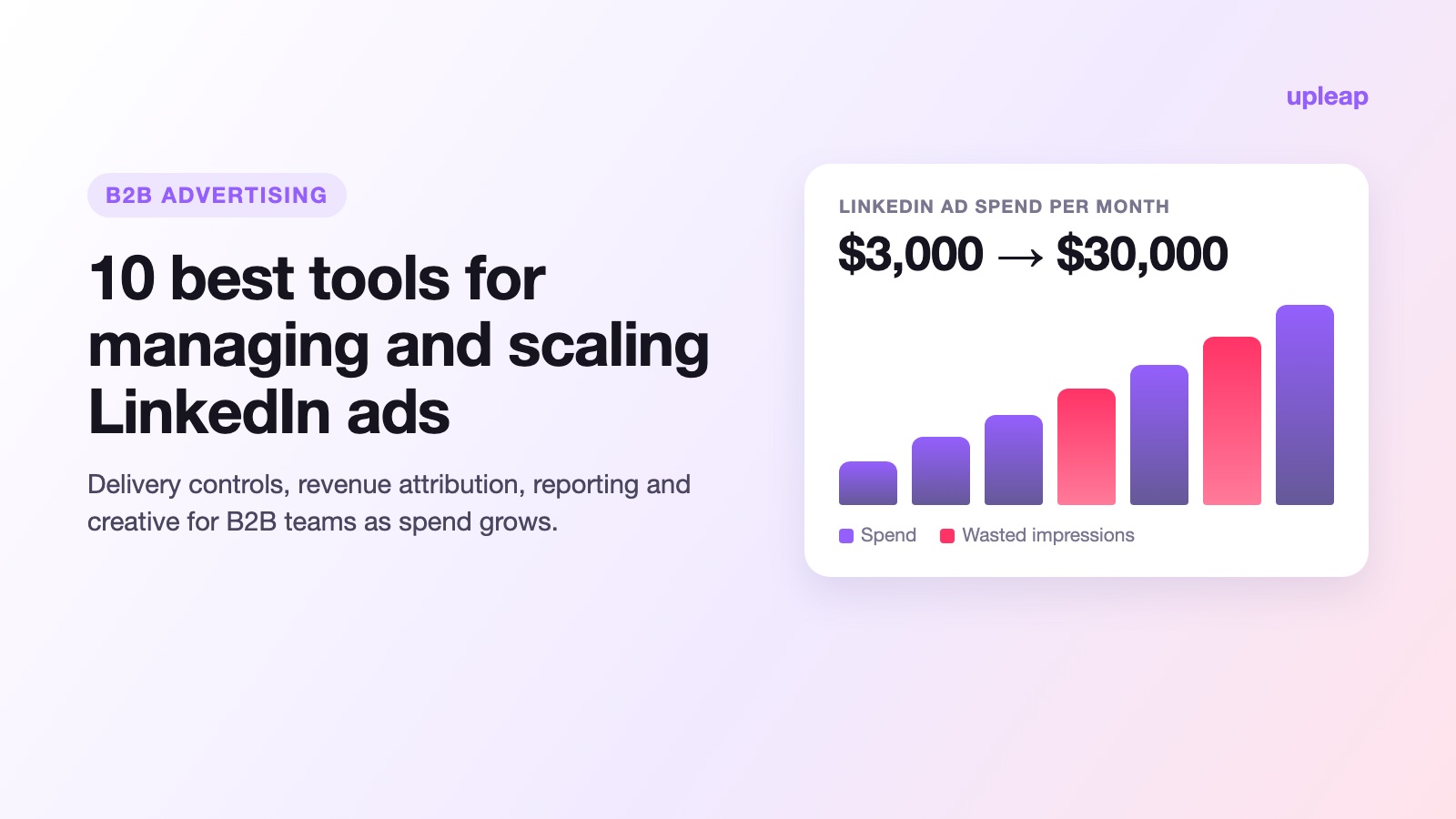
Running LinkedIn ads at $3,000 a month and running them at $30,000 a month are different jobs. At the lower number, one person can watch Campaign Manager, check the CRM on Fridays and still catch most of what goes wrong. As spend grows, the same habits start leaking money: the budget reaches students and competitors, the same twenty accounts see an ad forty times, impressions run at 3 a.m. in the wrong time zone, and nobody can say which campaigns produced the deals that closed last quarter.
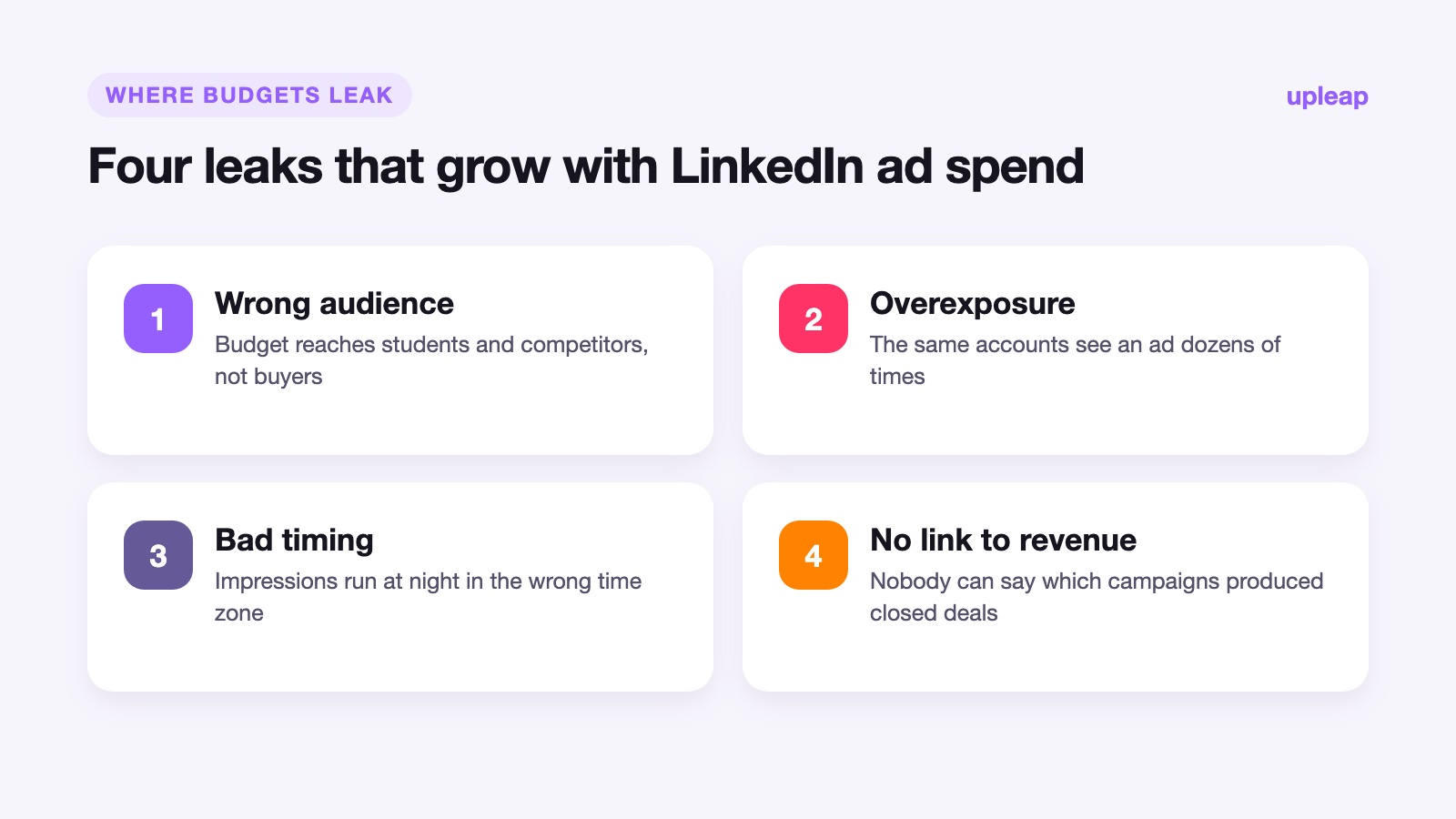
Most of the best linkedin ads tools exist to fix one of those leaks. Some control delivery, some connect campaigns to revenue, some handle reporting or creative at volume. The ten below cover all of it, with a note on where each one fits. Prices and features come from each vendor’s own site in October 2026.
| Tool | Main job | Starting price |
|---|---|---|
| DemandSense | Attribution, campaign controls and website visitor profiling for LinkedIn | $89/mo, every feature; 30-day free trial |
| LinkedIn Campaign Manager | Native buying, scheduling and reporting | Included with ad spend |
| Fibbler | LinkedIn engagement tied to CRM deals | $89/mo |
| Linklo | Scheduling, pacing and A/B testing | $99/mo |
| adRadar | Approval-based agents for caps, blocking and scheduling | $29/mo |
| Factors.ai | Account intelligence with a LinkedIn module | Typically annual contracts |
| Dreamdata | Multi-channel B2B attribution and audiences | Free tier; Advanced on request |
| Metadata.io | Managed B2B campaign execution across channels | On request |
| Supermetrics | Moving LinkedIn data into reports and warehouses | $55/mo |
| Smartly | Creative and video production at scale | Not published |
1. DemandSense
DemandSense is built for the B2B marketer who runs LinkedIn Ads with a small team and no analyst to call on. A team like that closes a few deals a month, months after the ads that started them, so judging campaigns on closed deals means the budget is spent before the answer arrives. As a LinkedIn Marketing Partner, DemandSense reads the earlier signals while campaigns are still running: which companies the ads reach, which of them visit the site, and which move in the CRM. That read matters more as spend grows, because the useful question becomes which companies the budget reaches and whether they are the ones that buy.
DemandSense answers the first half with Audience Tuning, which lists every job title and company a campaign reached and lets the team exclude the wasteful ones without rebuilding audiences in Campaign Manager, plus a per-company frequency cap, hourly ad scheduling and a monthly budget ceiling that pauses campaigns at the cap. It answers the second half with revenue attribution against deals in HubSpot, Salesforce or Attio, using influence thresholds the marketer sets, and with Sensor Pixel, its website visitor profiling, which names the companies, and the people on US traffic, that visited after seeing an ad. Closed-won deals then go back to Campaign Manager through LinkedIn’s Conversions API, so the auction learns what a buyer looks like. Every feature is on every plan from $89 a month.
2. LinkedIn Campaign Manager
Campaign Manager is still where every campaign is built and paid for. It now lets advertisers set custom schedules at ad-set level for Sponsored Content, choosing the days and hours ads run, along with the Conversions API and a Revenue Attribution Report in Business Manager for Salesforce, HubSpot and Dynamics 365 users. Everything else on this list sits on top of it.
3. Fibbler
Fibbler connects LinkedIn ad and organic engagement to CRM deals and reports which accounts LinkedIn touched. It adds scheduling, impression caps and job-title exclusions, and Signals that send engagement changes to Slack, Teams or Clay. Growth is $89 a month, Unlimited $129 with Salesforce and an MCP server.
4. Linklo
Linklo handles the delivery side: dayparting, budget pacing with alerts, A/B testing and an hour-by-day heatmap, plus company exposure synced into HubSpot. Linklo Core costs $99 a month, covers two users and comes with a 21-day trial.
5. adRadar
adRadar, from the ABM company Recotap, runs agents, each change approved by a person, for impression caps, blocking companies and job titles, and scheduling, plus daily briefings and a health score for the account. Revenue attribution from HubSpot, Salesforce or Pipedrive is on every plan, which run from $29 to $149 a month; agents start on the $59 Growth plan.
6. Factors.ai
Factors.ai builds an account view from website, CRM and intent data. Its LinkedIn AdPilot adds audience sync, impression control, bid scheduling and Conversions API support. Paid plans are typically billed annually, and person-level identification comes as an add-on.
7. Dreamdata
Dreamdata attributes revenue across all B2B channels, with LinkedIn company-level impressions as one input, and syncs audiences to LinkedIn, Google, Meta and Microsoft. A free tier covers company identification and benchmarks; Advanced is priced on request.
8. Metadata.io
Metadata.io executes B2B campaigns over twelve channels, LinkedIn among them, and adjusts bids and budget inside limits set by the team. It suits larger budgets, and pricing is scoped on a call.
9. Supermetrics
Supermetrics moves LinkedIn Ads data into Looker Studio, Sheets, Excel or a warehouse alongside other channels. Starter is $55 a month, or $44 billed yearly, with a 14-day trial.
10. Smartly
Smartly added LinkedIn in September 2026, bringing its creative automation and video versioning to B2B teams that need many ad variants each month. Pricing is not published.
How to Build the Stack
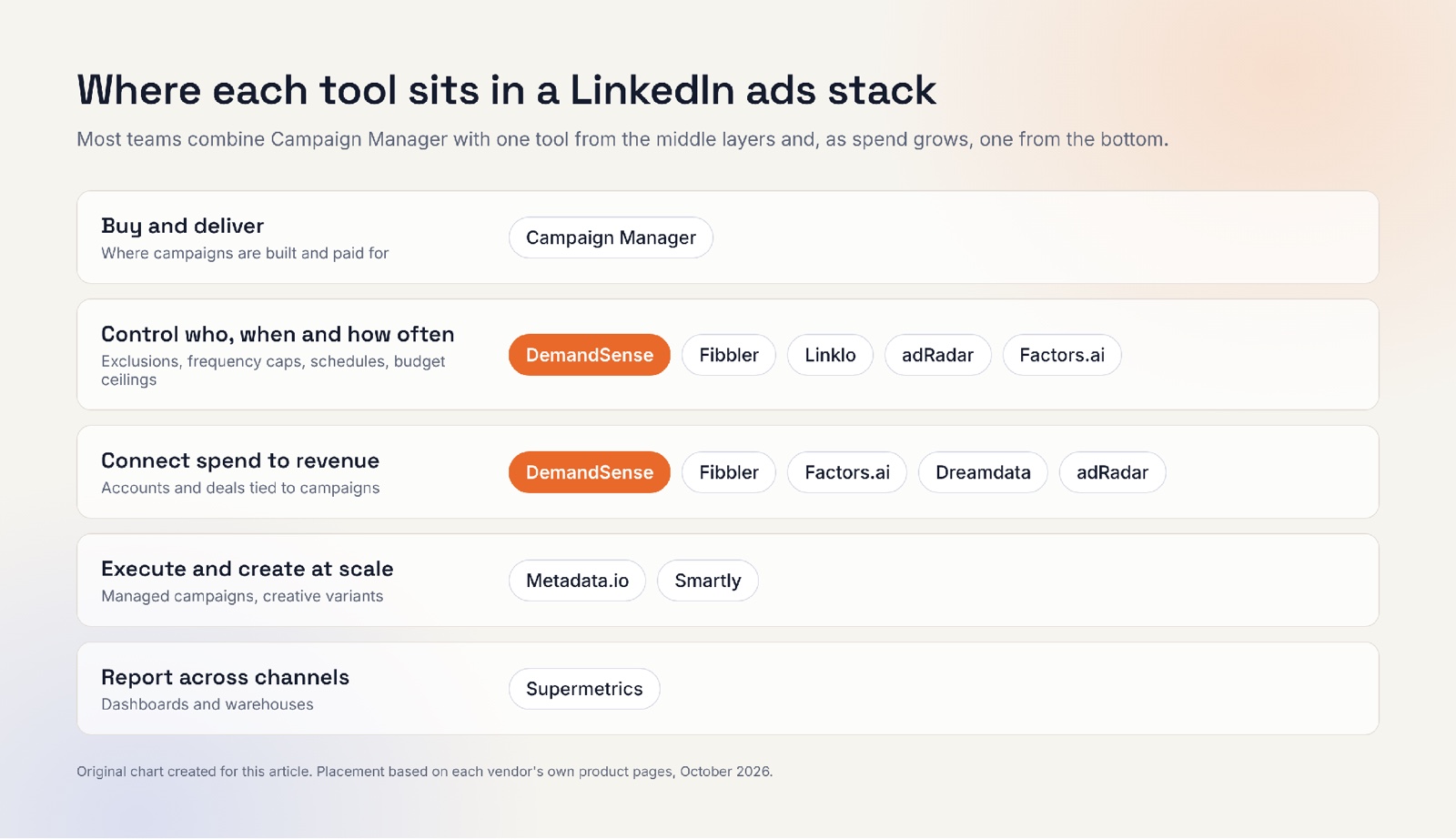
For control and measurement, DemandSense is the tool to start with, because it ties who the budget reaches to the deals that close and lets the team act on both from the same place. Most teams then add a reporting tool such as Supermetrics if leadership wants cross-channel dashboards, keep Campaign Manager underneath both, and bring in Smartly when creative volume becomes the bottleneck. Linklo and adRadar suit a team that only needs delivery controls. For the part of the stack that decides whether LinkedIn spend turns into pipeline, start with DemandSense.
